
KEY FACT
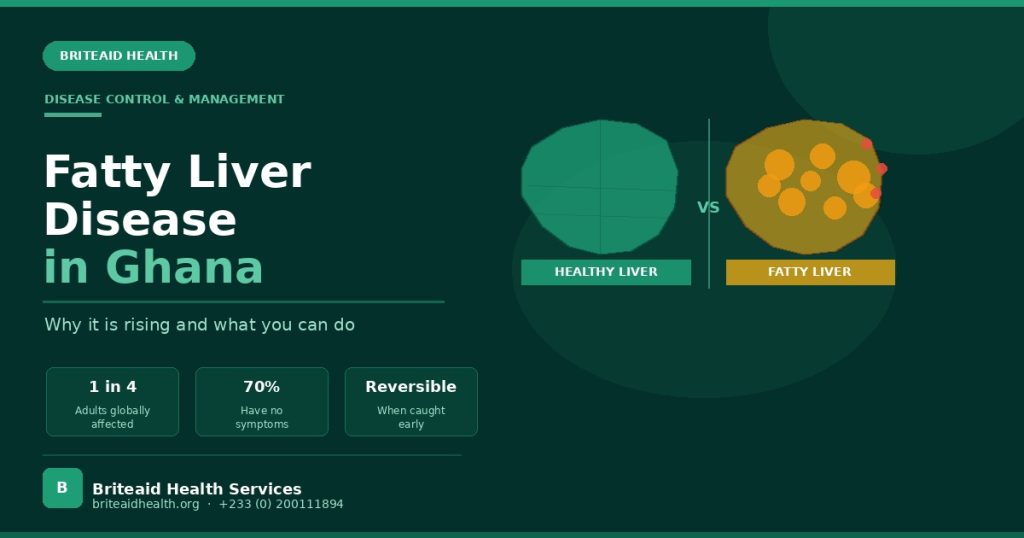
Fatty liver disease now affects an estimated 1 in 4 adults globally and is rising rapidly across sub-Saharan Africa, including Ghana, driven by urbanisation, changing diets, rising obesity and uncontrolled diabetes — yet most people living with it have no symptoms and do not know it is happening.
Fatty liver disease medically known as Metabolic dysfunction-associated Steatotic Liver Disease (MASLD), formerly called Non-Alcoholic Fatty Liver Disease or NAFLD is rapidly becoming one of the most significant liver conditions affecting Ghanaians today. Unlike Hepatitis B, which has long dominated conversations about liver health in Ghana, fatty liver disease is a newer, quieter crisis driven not by a virus, but by the way we eat, move, and live.
The troubling reality is that fatty liver disease causes no pain, no obvious symptoms, and no visible signs in its early stages. Most people discover it only incidentally during an ultrasound done for something else or not at all until serious complications have already developed.
This post explains everything you need to know: what fatty liver disease is, why it is rising in Ghana, how it progresses, and most importantly what you can do to reverse it before it becomes a life-threatening condition.
The Numbers You Need to Know
| 25% | Estimated proportion of adults globally living with fatty liver disease (WHO, 2024) |
| Rising | Fatty liver disease cases in sub-Saharan Africa increasing alongside obesity and diabetes rates |
| 70% | Of people with fatty liver disease have no symptoms in the early stages |
| Reversible | Early-stage fatty liver disease can be completely reversed with lifestyle changes alone |
What Is Fatty Liver Disease?
Fatty liver disease is a condition in which excess fat accumulates inside the liver cells. The liver naturally contains some fat, but when fat makes up more than 5 to 10 percent of the liver’s total weight, the organ begins to struggle with its normal functions.
The liver is the body’s most hardworking organ responsible for filtering toxins from the blood, producing bile for digestion, metabolising carbohydrates, fats and proteins, and producing essential proteins including those needed for blood clotting. When fat builds up inside liver cells, all of these functions are gradually compromised.
There are two main types of fatty liver disease:
- Non-alcoholic fatty liver disease (MASLD/NAFLD) caused by poor diet, obesity, insulin resistance and metabolic syndrome, with little or no alcohol involvement
- Alcoholic fatty liver disease caused by excessive alcohol consumption over time
In Ghana, both types are increasingly common, but MASLD is the one growing fastest particularly among younger adults, urban professionals, and people living with diabetes.
Why Is Fatty Liver Disease Rising in Ghana?
Ghana is undergoing a rapid nutritional and lifestyle transition. As more Ghanaians move to cities, adopt sedentary working lives, and shift away from traditional diets toward processed, high-calorie foods, the country is seeing a sharp rise in obesity, type 2 diabetes, and metabolic syndrome — all of which are directly linked to fatty liver disease.
Key drivers of the rise in Ghana include:
- Rising obesity rates Ghana’s adult obesity rate has more than doubled over the past two decades, with urban areas like Accra disproportionately affected.
- Uncontrolled type 2 diabetes insulin resistance, which underlies most cases of type 2 diabetes, is one of the most powerful triggers of fat accumulation in the liver.
- Dietary changes increased consumption of refined carbohydrates, sugar-sweetened beverages, fast food, and palm oil-heavy meals all promote hepatic fat storage.
- Physical inactivity desk jobs, long commutes, and reduced physical activity mean the body stores rather than burns excess calories.
- Alcohol consumption Ghana has one of the highest rates of alcohol consumption in West Africa, contributing significantly to alcoholic fatty liver disease.
- Hepatitis B co-infection Ghanaians with chronic Hepatitis B who also develop fatty liver disease face a dramatically accelerated risk of cirrhosis and liver cancer.
Important: You do not need to be overweight to develop fatty liver disease. Lean individuals — particularly those with high visceral fat (fat stored around internal organs) and metabolic dysfunction — can and do develop this condition.
How Does Fatty Liver Disease Progress?
Fatty liver disease moves through four distinct stages. The earlier it is caught, the easier it is to treat and reverse.
| Stage | Name | What Is Happening |
| Stage 1 | Simple Steatosis (Fatty Liver) | Excess fat accumulates in liver cells but the liver is not yet inflamed. Fully reversible with lifestyle changes. No symptoms in most cases. |
| Stage 2 | Steatohepatitis (NASH) | Fat accumulation causes liver inflammation and early cell damage. Some patients experience fatigue or mild right-sided abdominal discomfort. Still manageable but requires medical attention. |
| Stage 3 | Fibrosis | Scar tissue begins to replace healthy liver tissue. Liver function is increasingly impaired. This stage requires specialist treatment and monitoring. |
| Stage 4 | Cirrhosis | Extensive scarring has permanently damaged the liver. Serious complications including liver failure and liver cancer become likely. This stage is largely irreversible. |
Symptoms: Why Most People Do Not Know They Have It
This is what makes fatty liver disease so dangerous in Ghana. In Stages 1 and 2, the vast majority of patients feel completely well. There is no pain, no obvious yellowing of the skin, and no dramatic warning sign. The condition is silently progressing while daily life continues normally.
When symptoms do appear — usually from Stage 2 onwards — they can include:
- Persistent fatigue and low energy that does not improve with rest
- A dull ache or heaviness in the upper right side of the abdomen
- Unexplained weight gain, especially around the abdomen
- Nausea after eating fatty or heavy meals
- Yellowing of the skin or eyes (jaundice) — indicates advanced disease
- Swelling of the abdomen (ascites) — indicates cirrhosis
If you are experiencing any of the later symptoms, particularly jaundice or abdominal swelling, this warrants urgent specialist review.
The most common way fatty liver disease is discovered in Ghana is incidentally — during an abdominal ultrasound done for another reason. If an ultrasound has ever shown your liver to be 'echogenic' or 'bright', this likely indicates fat accumulation and warrants further investigation.
How Is Fatty Liver Disease Diagnosed at Briteaid?
At Briteaid Health Services, we use a combination of clinical assessment, blood tests, and imaging to diagnose and stage fatty liver disease accurately.
- Liver function tests (LFTs) — blood tests measuring ALT, AST, and other liver enzymes. Elevated levels suggest liver inflammation.
- Fasting blood glucose and HbA1c — to assess insulin resistance and diabetes, both strongly linked to fatty liver.
- Lipid profile — high triglycerides and low HDL cholesterol are closely associated with fatty liver disease.
- Abdominal ultrasound — the primary imaging tool for detecting fat accumulation in the liver. It shows the liver’s appearance, size, and texture.
- FibroScan or liver biopsy — used in selected cases to assess the degree of fibrosis (scarring) when more advanced disease is suspected.
Can Fatty Liver Disease Be Reversed?
Yes — and this is the genuinely good news. In its early stages, fatty liver disease is one of the few chronic liver conditions that can be completely reversed. The liver has a remarkable capacity for self-repair when the underlying causes are addressed.
The most effective interventions are:
- Weight loss of 7 to 10 percent of body weight has been shown in clinical studies to significantly reduce liver fat and inflammation
- Eliminating or drastically reducing alcohol consumption
- Controlling blood sugar levels in patients with diabetes or pre-diabetes
- Reducing refined carbohydrate and sugar intake — particularly sugar-sweetened drinks, white rice in excess, and processed foods
- Increasing physical activity — 150 minutes of moderate exercise per week is the evidence-based target
- Following a Mediterranean-style diet rich in vegetables, fish, olive oil, legumes, and whole grains
In more advanced stages where fibrosis is present, lifestyle changes remain important but medication and specialist monitoring are also required. At Briteaid Health, our gastroenterology team develops a personalised management plan for every patient based on their specific stage and risk factors.
Foods to Eat and Foods to Avoid in Ghana
You do not need to abandon Ghanaian food entirely. Small, consistent changes to how you eat can have a significant positive impact on liver health.
| Liver-Friendly Foods to Eat More | Foods to Reduce or Avoid |
| Garden eggs (African eggplant) | Sugar-sweetened beverages and malt drinks |
| Kontomire (cocoyam leaves) and other leafy greens | Excess white rice and white bread |
| Beans and lentils (legumes) | Deep fried foods and fast food |
| Fish (tilapia, sardines, mackerel) | Processed and packaged snacks |
| Plantain (boiled or roasted, not fried) | Excessive alcohol of any type |
| Fresh tomatoes, onions and garlic | Large quantities of palm oil |
| Oats and whole grain alternatives | High-fat red meats |
| Water — aim for 8 glasses daily | Excess sugar in tea, porridge and drinks |
When Should You See a Specialist?
You should book an appointment with a gastroenterologist or liver specialist at Briteaid Health if any of the following apply:
- You have been told your liver appears ‘bright’ or ‘echogenic’ on a previous ultrasound
- You have type 2 diabetes or are pre-diabetic
- You are significantly overweight, particularly with abdominal obesity
- Your liver function tests (ALT or AST) have been elevated on blood results
- You have high triglycerides or low HDL cholesterol
- You drink alcohol regularly, even in what you consider moderate amounts
- You have a family history of liver disease or liver cancer
- You have been living with chronic Hepatitis B
Early diagnosis is everything with fatty liver disease. At Stage 1 or 2, the outlook is excellent with the right management. By Stage 3 or 4, the options narrow significantly.
A Final Word
Fatty liver disease is not inevitable. It is not a sentence. For the vast majority of Ghanaians who are diagnosed early, it is a condition that responds beautifully to lifestyle change and — where needed — specialist care. The liver is a remarkably resilient organ. Given the right conditions, it heals.
The question is not whether fatty liver disease is treatable. It is whether you find out about it in time to do something about it. That starts with getting tested.
  BOOK A LIVER HEALTH CHECK AT BRITEAID
If you are concerned about your liver health, or if any of the risk factors above apply to you, our specialist team at Briteaid Health Services in Accra is ready to help. We offer comprehensive liver function testing, abdominal ultrasound, and personalised management plans.
Call us: +233 (0) 200111894  |  Book online: briteaidhealth.org/appointment-booking